- Home
- School of Law
- Academics
- Class Assignments
- Class Schedule
- Final Exam Schedule
- Important Dates
- Financial Aid Links
- Book Requirements
- Campus Connection
- Course Descriptions
- Online Graduation Application
- Forms
- Scholarships
- Outside Employment
- Summer Study
- Table of Contents
- General Provisions
- Conduct Prohibited
- Honor Board
- Pre-Hearing Procedure
- Hearings
- Sanctions Findings Records
- Review of Decisions
- Notes
- Table of Contents
- General Requirements
- General Rules
- Final Examinations
- Academic Disqualification and Grievances
- Transfer, Visiting and Non-Degree Students
- General Policies
- Lawyering Skills
- Academic Success
- Clinical Education
- Joint Degree Program
- Indian Law Certificate
- Central Legal Research
- Norway Program
- Other Academic Credit
- Summer Study
- Black Law Students Law Association
- Criminal Law Association
- Delta Theta Phi
- Environmental Law Society
- Federalist Society
- International Human Rights
- Journal of Law and Interdisciplinary Studies
- Law Review
- Law Women's Caucus
- Moot Court Association
- Native Americans Into Law
- Native American Law Student Association
- Phi Alpha Delta
- Phi Delta Phi
- Public Interest Law
- Sports Law
- Sports (participation)
- Student Bar Association
- Student Trial Lawyers
Academics
The educational program of the School of Law is designed to provide education and training in legal analysis and the application of legal principles leading to professional competence. The School emphasizes an understanding of the operation of law, which creates and interprets bodies such as the judiciary, the legislature, administrative agencies and executive departments. It also emphasizes the manner in which the decision-making process in each of these takes place. The legal process itself, as well as the law which emerges as its consequence, is an important subject of inquiry in the School of Law.
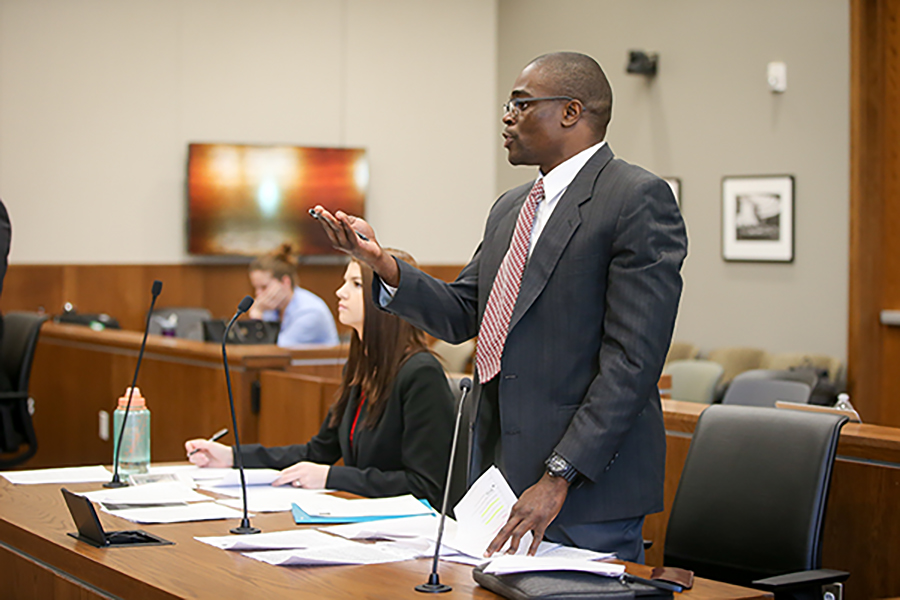
Instructional techniques in the School of Law are designed to challenge the imagination and ability of the student. The case method is employed in most first-year courses to stimulate the students own capacity for intellectual evaluation and logical deduction, to encourage meticulous reading habits and to present models of the evolution of legal principles. In upper division classes, lectures are used when appropriate, and there is emphasis on problem-solving techniques and skills training. Also available to upper-class students are seminars which encourage group discussion and , at the same time, offer opportunities for individual research under personal faculty supervision. To stimulate active learning, instructors utilize the school's multimedia courtroom as a teaching laboratory. Their use of video tape during trial and appellate arguments allows the faculty to provide immediate and graphic feedback to the student. Professors also utilize computer data projection equipment for classroom enhancement.